When Scientific Authority Becomes Law
Who governs science when no one is in charge: Part 5 of a five-part series

Editor’s Note: This weekly series explores how science is governed globally in the absence of a world authority, beginning with the myth and reality of coordination without control.
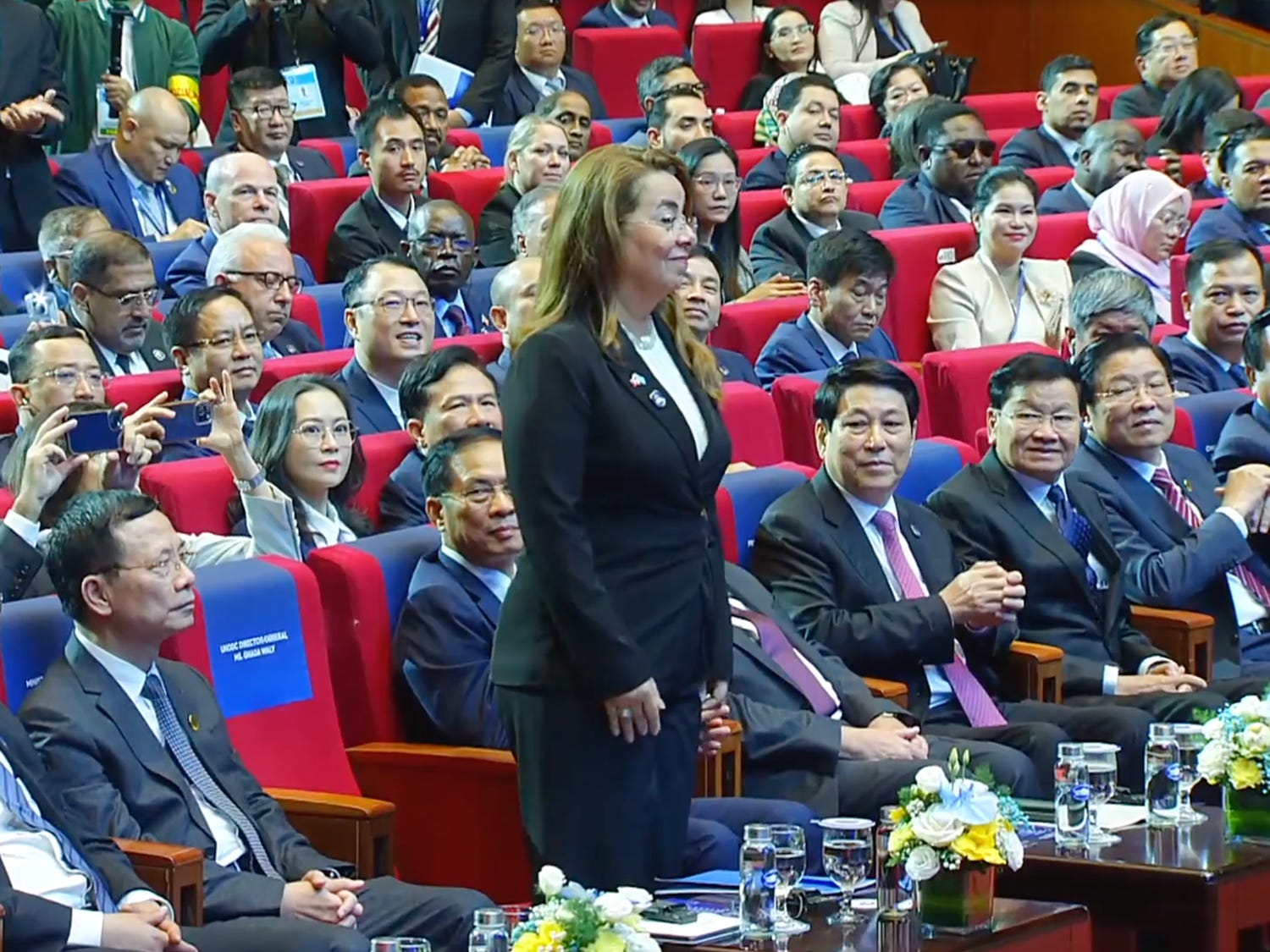
In Hanoi last October, senior officials lined up to sign what U.N. Secretary-General António Guterres called a “historic occasion” — the launch of the Convention against Cybercrime, the first new global criminal justice treaty in more than two decades.
Sixty-five nations became initial supporters. The U.N. General Assembly had adopted the text by consensus months earlier. “In cyberspace, nobody is safe until everybody is safe,” Guterres said at the ceremony. “One vulnerability anywhere can expose people and institutions everywhere.”
Unlike advisory panels or technical standards bodies, this instrument is legally binding once ratified. It establishes mechanisms for cross-border investigations and digital evidence sharing, along with extradition cooperation and asset seizure.
Ghada Waly, who heads the U.N. Office on Drugs and Crime, described it as “a paradigm shift” that “fills urgent gaps in the global response to cybercrime and provides a practical launchpad for collective action.”
Here, science and technology governance crossed a threshold from coordination to law, but that threshold is not where most science diplomacy operates.
A Spectrum of Authority
At the International Telecommunication Union, countries negotiate technical standards that shape how mobile networks function worldwide without being legally binding. At the World Health Organization, expert committees assess evidence that can trigger emergency declarations but cannot compel governments to act. At the Intergovernmental Panel on Climate Change, scientists evaluate research that frames negotiations without dictating outcomes.
In June 2025, nations meeting in Punta del Este, Uruguay, created yet another model: a new global panel on chemicals, waste and pollution under the auspices of the U.N. Environment Program. The panel is expected to conduct “global assessments, identify knowledge gaps, communicate complex science in policy-friendly formats, and integrate capacity for national decision-making.”
“This is the first step in delivering meaningful action to address our global waste and pollution crisis,” UNEP Executive Director Inger Andersen said at the conclusion of the negotiations. The new body joins the IPCC and the biodiversity panel IPBES as part of what UNEP views as a scientific “trifecta.”
Unlike the cybercrime convention, which regulates, the new pollution panel assesses. Between those poles lies the space most commonly occupied by science diplomacy: coordination without command.
How Law Emerges From Consensus
The cybercrime treaty begin not as an enforcement mechanism but as a proposal introduced in 2019 and negotiated for five years through committee rooms marked by procedural disputes and geopolitical tension. Its adoption by consensus in December 2024 did not eliminate disagreement. Civil society groups and technology companies warned about surveillance powers and cross-border data risks.
Yet consensus mattered. Without it, the convention would have lacked legitimacy as a universal framework. With it, countries that disagreed on specific provisions still accepted the institutional architecture.
Science diplomacy relies on this procedural norm. It allows countries to remain inside frameworks they might not design alone, converting negotiated compromise into institutional continuity.
Only occasionally does that continuity crystallize into binding law.
When Science Remains Advisory
By contrast, the new chemicals and waste panel reflects a different institutional choice.
Rather than negotiating treaty obligations, countries opted to create a science-policy body that can assess risks, synthesize evidence and support national decision-making. Its authority will depend on credibility, transparency and the uptake of its findings rather than ratification thresholds or enforcement clauses.
This mirrors the structure of the IPCC and IPBES, whose reports routinely anchor climate and biodiversity negotiations without carrying legal force.
It also resembles the U.N.’s evolving approach to artificial intelligence. The Independent International Scientific Panel on AI, launched under the Pact for the Future, must produce technical assessments ahead of a global policy dialogue. Guterres has framed the effort as part of a “practical architecture” designed to move countries “from philosophical debates to technical coordination.”
The AI initiative adds another layer: capacity building. Guterres proposed a $3 billion fund to expand computing power and technical expertise in developing countries, arguing that “the future of AI cannot be decided by a handful of countries or left to the whims of a few billionaires.”
Here again, authority is structured around knowledge and participation, not coercion.
Three Modes of Governance
Taken together, these cases reveal a spectrum. At one end: advisory science bodies that define evidence but do not negotiate policy. At the other end: treaties that transform negotiated text into legal obligations. In the middle: coordinative mechanisms that align standards, share information and set non-binding expectations.
Science diplomacy operates across all three modes, but is mostly situated toward one end and the middle of the spectrum — defining evidence and setting expectations. In a recent Science editorial, Vaughan Turekian, a prominent U.S. leader in science diplomacy and international policy, and Sir Peter Gluckman, president of the International Science Council, described the shift bluntly.
“Of late, there has been a shift to a transactional model, which takes on a more business-like approach with a focus on dealmaking, and near-term returns for the players within broader national strategy,” Turekian and Gluckman wrote. “Science’s value now is seen as not just a tool of cooperation but also as a currency of negotiation. Agreements are contingent, driven by near-term benefit, and increasingly aimed at advancing national interests.”
That distribution reflects political reality. Binding agreements are difficult to negotiate and harder to ratify. Advisory and coordinative institutions require lower thresholds of agreement. They can function amid rivalry, resource disparities and shifting alliances. The dynamic reflects political constraints rather than institutional failure.
The Limits of Legal Authority
Even when science diplomacy reaches the level of treaty law, enforcement remains contingent.
The cybercrime convention will enter into force only after 40 nations ratify it. Its implementation depends on domestic legislation, prosecutorial cooperation and political will. Countries can interpret provisions narrowly or broadly. Civil society oversight will shape how surveillance powers are exercised. That tension is not confined to cybersecurity law.
“Regulation versus innovation ... they don’t stand in opposition, but rather creating an environment that gives scientists and industry predictability and certainty that their products will not be misused can spur innovation in a safe space,” Izumi Nakamitsu, the U.N. undersecretary-general and high representative for disarmament affairs, told UNESCO’s Global Ministerial Dialogue on Science Diplomacy last year.
The same is true in reverse. Advisory panels do not compel action, but they can shape expectations so powerfully that deviation becomes costly. IPCC findings, for example, frame climate negotiations even when countries contest mitigation targets.
Authority in global science governance is layered rather than hierarchical. Legal instruments, expert assessments and technical standards interact; none alone governs the system.
Closing the Series
Across five parts, this series has examined standards committees, expert panels, consensus negotiations and institutional lag in the face of accelerating technology.
No global science authority sits above them. Instead, governance emerges from procedure: repeated meetings, documentation, adopted frameworks, ratified treaties, published assessments. Authority accrues through participation and persistence.
Sometimes it becomes law, but more often it stabilizes expectations.
The cybercrime convention demonstrates that consensus can harden into binding rules. The UNEP chemicals panel shows that countries still turn first to assessment when confronting complex risks. The AI architecture suggests that expertise and capacity may be assembled in parallel to regulation rather than after it.
Global science governance is distributed across institutions that vary in mandate and strength. When authority hardens into law, it depends on national implementation. When it stays advisory, it depends on credibility and uptake.
In both cases, science diplomacy functions less as command than as maintenance: sustaining channels, defining baselines and preventing fragmentation in domains where no single country can govern alone. The system works because enough participants continue to reproduce it.
Whether it will keep pace with accelerating technologies, ranging from AI to bioengineering to next-generation networks, remains the open question.