WHO assembly backs major health measures as financial strains mount
New strategies on antimicrobial resistance, financing and radiation protection approved - while doing 'more with less.'

GENEVA (AN) — The World Health Assembly concluded after member nations approved a broad package of resolutions and strategies on antimicrobial resistance, health financing, radiation protection and healthcare workforce recruitment amid growing concern over mounting pressure on the global health system.
During the weeklong gathering split between WHO’s headquarters and the Palais des Nations, delegates adopted more than 20 decisions and 13 resolutions covering issues including tuberculosis, stroke, liver disease, emergency care, precision medicine and antimicrobial resistance.
As WHO’s highest decision-making body, the World Health Assembly meets annually in Geneva to determine the organization’s policies and priorities. It approved what WHO described as a reform of the global health architecture through a member nation-led, WHO-hosted joint process.
Among the most significant measures adopted before the end of the final session on Saturday afternoon was a new WHO strategy on the economics of health for all for 2026–2030, which seeks to place health, equity and well-being more centrally within economic and fiscal policymaking.
The strategy reflects growing concern among health officials that many governments are struggling to sustain health care systems amid rising debt pressures, shrinking aid budgets and competing geopolitical priorities.
Delegates also approved an updated Global Action Plan on Antimicrobial Resistance covering 2026–2036.
WHO warned that 1-in-6 common bacterial infections reported in 2023 were resistant to antibiotics and that antimicrobial resistance was associated with an estimated 4.71 million deaths in 2021. Without urgent action, WHO said, antimicrobial resistance could contribute to as many as 39 million deaths by 2050.
Member nations additionally approved the first World Health Assembly resolution specifically addressing radiation and health, covering both ionizing and non-ionizing radiation exposure. The measure calls for stronger monitoring systems, workforce training and integration of radiation risk management into broader public-health programs.
Countries also agreed to amend the WHO Global Code of Practice on the International Recruitment of Health Personnel for the first time since its adoption in 2010.
The revisions expand provisions covering internationally recruited care workers and seek to strengthen ethical standards governing health-worker migration during emergencies.
The assembly also unfolded amid widening geopolitical tensions and mounting financial pressure on international health institutions. Delegates spent part of the week debating measures linked to conflicts in Gaza, Lebanon, Iran and Ukraine while WHO itself continued restructuring after major funding losses and staff reductions.
WHO told member nations this week that more than 2,500 staff separations had already occurred worldwide as the organization restructures operations following severe budget shortfalls.
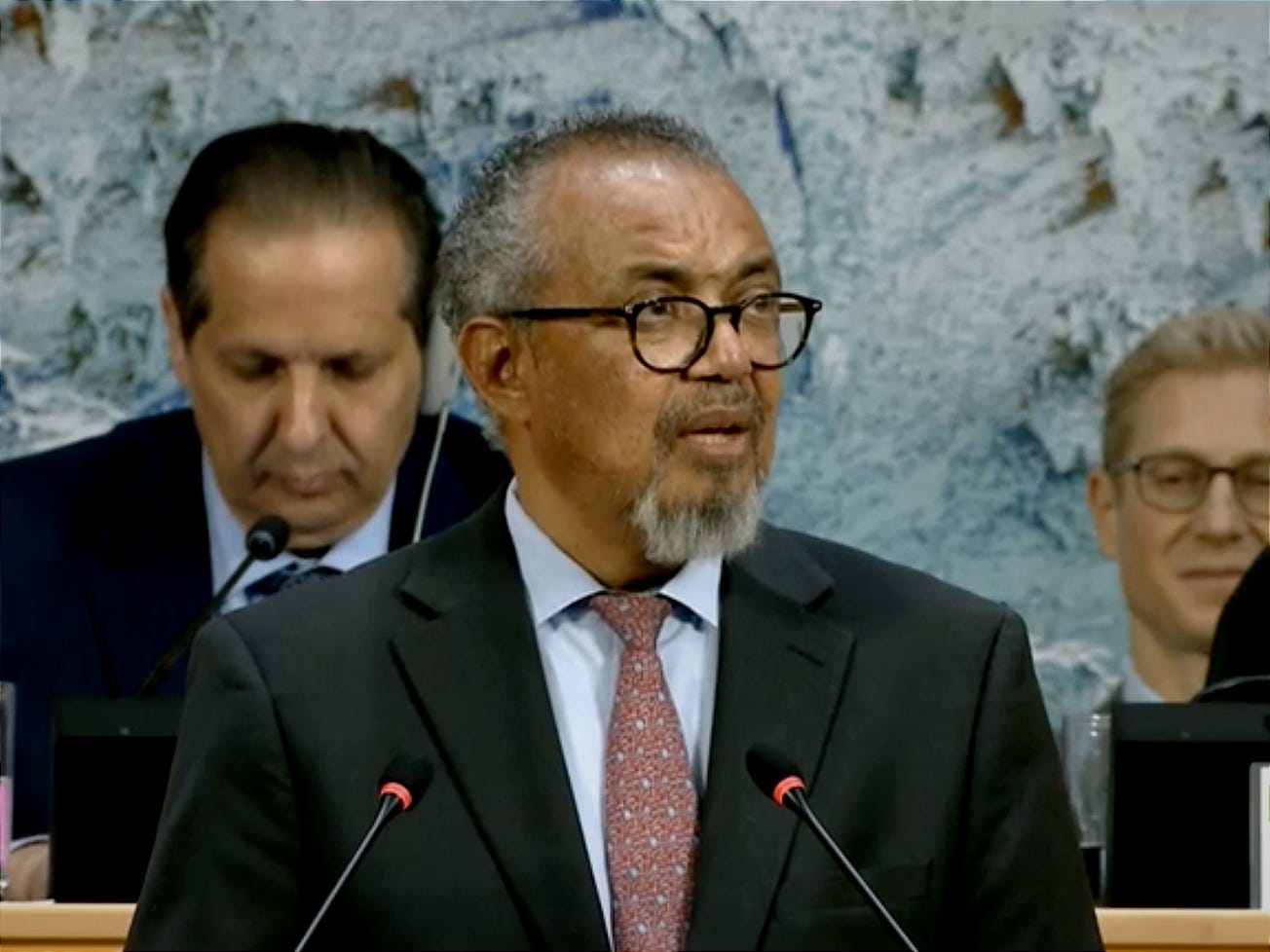
In his closing remarks, WHO Director-General Tedros Adhanom Ghebreyesus emphasized that the resolutions adopted during the assembly would matter only if they translated into practical improvements in health care delivery.
“Every resolution you adopt, every agreement you reach, only has value when it changes what happens in a clinic, in a community, or in a household,” Tedros said. “When a health worker has what they need to do their job; when a child is vaccinated; when a mother survives childbirth; when an outbreak is contained before it spreads.”
He said implementing the measures would require “political commitment, sustained financing, and continued cooperation between member states, partners and communities.”
The assembly unfolded amid ongoing concern over emergency outbreaks, including Ebola in Central Africa.
On Friday, U.N. humanitarian chief Tom Fletcher announced that up to $60 million would be released from the Central Emergency Response Fund to accelerate the response to the Ebola outbreak in Congo and neighboring countries.
Momodou Mbenga, first secretary at Ghana’s U.N. mission in Geneva, said this year’s gathering felt “normal” to some extent but also under pressure from simultaneous health emergencies and financial constraints.
“There’s a sense of urgency to have a reform,” Mbenga said. “This is a bit different right now because we do feel like we are dealing with real health emergencies in the wake of a bad financial crisis.”
Mbenga said WHO was increasingly being forced to ration limited resources while trying to respond to multiple crises at once. “The WHO is trying to do more with less,” he said. “The resources are not growing, so they are now rationing.”
He added that the organization’s financial difficulties now appear more severe than during previous assemblies. “I think the crisis is getting worse and worse,” Mbenga said. “Now with the financial one, the WHO doesn’t have much to execute most of its operations and that has affected most of these programs.”

