Who protects the cables that carry the internet?
An international effort led by ITU is trying to strengthen one of the world's least visible but most important forms of infrastructure: the submarine cables that carry virtually all data traffic.

GENEVA — The global economy depends on a network that most people never see.
Hidden beneath the oceans, hundreds of submarine telecommunications cables carry 99% of all intercontinental data traffic, connecting countries, financial markets, governments, cloud computing systems, hospitals, universities and billions of internet users around the world.
The cables are often described as the backbone of the internet. Despite their importance, they remain largely invisible outside a small community of engineers, telecommunications companies, regulators and maritime specialists.
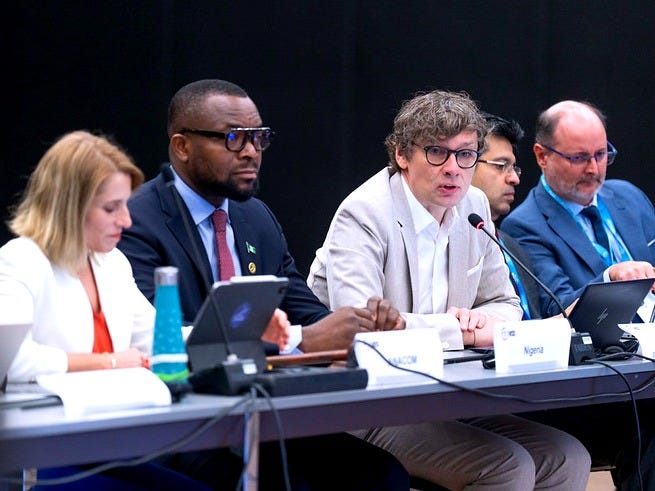
An international advisory body convened by the International Telecommunication Union approved a final report on Friday aimed at strengthening the resilience of the global submarine cable network, concluding a two-year effort involving governments, industry, international organizations and technical experts.
The recommendations cover everything from faster repair procedures and improved monitoring to greater route diversity and protection for vulnerable regions. Behind the technical language lies a broader question: who is responsible for protecting one of the most critical pieces of infrastructure in the modern world?
The infrastructure beneath the infrastructure
Most people imagine the internet as something wireless. In reality, almost every international digital interaction eventually reaches a physical cable lying on the seabed.
A video call between Geneva and Washington. A financial transaction between London and Singapore. Cloud computing services used by a hospital in Nairobi. Data transfers supporting artificial intelligence systems. At some point, those communications are likely to travel through fiber-optic cables stretched across oceans.
The system has evolved dramatically since the first submarine telegraph cable was laid between England and France in 1851. Today the global network consists of hundreds of cable systems spanning more than a million kilometers and linking nearly every connected nation on Earth.
The cables have become so fundamental that their disruption can affect economies, emergency communications, government services and financial systems within minutes. “The resilience of submarine cable systems has become a matter of strategic importance,” the report concludes.

A wake-up call from Tonga
One event appears repeatedly in discussions about cable resilience.
In January 2022, the eruption of Hunga Tonga-Hunga Ha’apai, an underwater volcano, severed Tonga’s only international submarine cable. The island nation was effectively cut off from much of the outside world for five weeks while repair crews struggled to reach the damaged infrastructure.
Tonga's cable, put into use in 2013, was built with aid from the Asian Development Bank and World Bank. The damage to it exposed a vulnerability that extends far beyond the Pacific.
Many countries, particularly small island developing nations and other geographically isolated regions, remain dependent on only one or a small number of cable systems. A single break can leave entire populations disconnected. The problem is not limited to remote islands.
“Geographical concentration of infrastructure creates systemic vulnerabilities,” the report warns. “A substantial share of global traffic passes through a limited number of maritime chokepoints and major cable corridors. Disruptions in these areas can therefore affect connectivity across multiple regions simultaneously.”
As dependence on digital infrastructure grows, even a single cable break can have national and regional consequences.
Earlier this month, Irish Taoiseach, Micheál Martin, told European officials in Brussels that maritime security is “extremely important” and cited Tyndall National Institute research about how to better protect cable systems off Irish coasts.
“What’s quite clear is that technology is going to play a key role here, particularly when it comes to protecting the undersea cables,” he said.
European Commission President Ursula von der Leyen, speaking during a visit to Ireland, also highlighted the need to strengthen maritime security but respect data protections. “I understand your question that we need a good balance between surveillance and privacy,” she told reporters, adding that new research on acoustic signals could help provide that balance.
Governance without a government
The submarine cable system presents a familiar challenge in global governance. Most cables are privately financed and operated. Governments regulate territorial waters and landing rights; international organizations establish standards and facilitate cooperation; and maritime authorities oversee navigation.
Repair ships move between jurisdictions while technical experts develop best practices and investors finance new routes. Responsibility is distributed across a complex ecosystem. No single government, company or international organization controls the global cable network.
The International Advisory Body on Submarine Cable Resilience was created in 2024 by the ITU and the International Cable Protection Committee, bringing together governments, industry representatives, regulators, academics and international organizations.
Its purpose was not to create a new regulatory regime. Instead, it sought to identify practical measures that different actors could implement to improve resilience across the system. The approach reflects a broader trend visible across many areas of technology governance: international coordination without centralized control.
The emerging risks
The report identifies several sources of vulnerability. Some are familiar. Fishing activity and ship anchors remain among the most common causes of cable damage. Natural hazards, including earthquakes and volcanic activity, also pose significant risks.
Others reflect changing technological and geopolitical realities. Repair times are increasing in some regions because of permitting delays, regulatory complexity and limited repair resources.
Climate-related threats are becoming more prominent as changing environmental conditions affect coastal infrastructure and seabed stability.
The concentration of global traffic through a limited number of routes creates systemic vulnerabilities that become more significant as societies digitize more aspects of economic and social life.
The report largely avoids framing these challenges through the lens of conflict or sabotage. Instead, it focuses on resilience — the ability of the network to continue functioning or recover quickly when disruptions occur.
“No region, country, or stakeholder can address the challenges we face alone. Cooperation is not an option; it is indispensable in an interconnected world,” the Advisory Body’s co-chairs Bosun Tijani and Sandra Maximiano, officials in Nigeria and Portugal respectively, wrote in the report.
Building resilience
The advisory body’s recommendations focus on several recurring themes.
Governments are encouraged to streamline permitting procedures for cable deployment and repair. Industry and public authorities are urged to improve coordination and information sharing. Greater route diversity and redundancy are identified as priorities for reducing dependence on individual cable systems or corridors. Investment is encouraged in underserved regions where resilience remains limited.
The report also emphasizes the importance of monitoring, preparedness and international cooperation. The recommendations amount to a governance agenda for an infrastructure system that has become indispensable but remains poorly understood outside specialist circles.
“A robust and efficient global repair system requires coordinated action across governance, financing, and operations,” the report notes, pointing to the need to “strengthen system-wide preparedness, accelerate incident response, and enhance the repair capacity of the global submarine cable ecosystem.”
One obstacle is that cable operators are often reluctant to share information about incidents and vulnerabilities. To address that problem, the report proposes a voluntary reporting system modeled partly on aviation safety reporting, where data can be shared without exposing commercially sensitive information.
The recommendation draws on approaches used by the International Civil Aviation Organization as well as cybersecurity and financial-sector reporting systems.
“By advocating for a voluntary, anonymized, and disassociated reporting mechanism,” the report says, “the proposed framework respects commercial and security sensitivities while addressing the urgent need for actionable source information.”


