

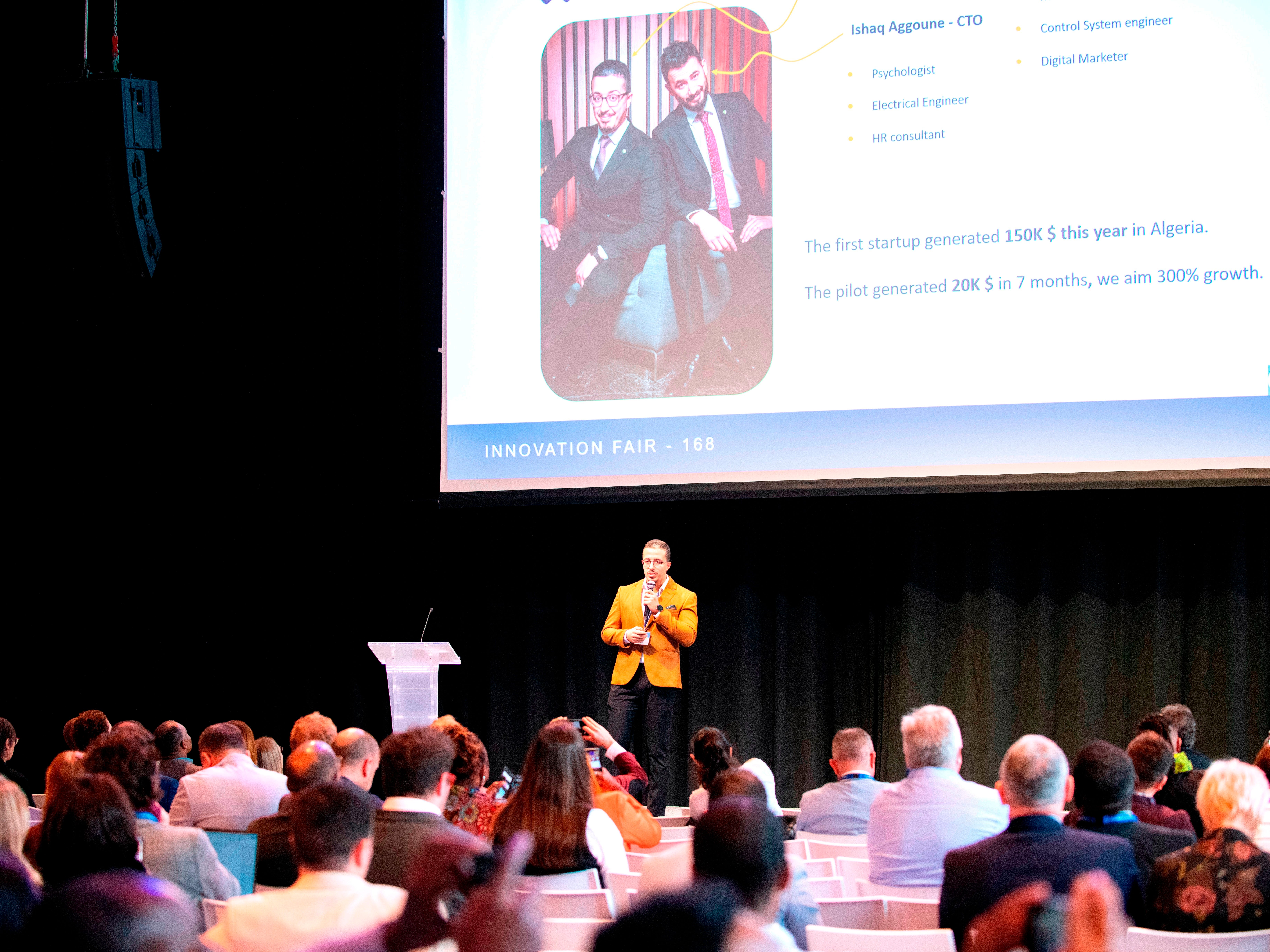
Europe and Africa have spent years building research and innovation partnerships across food security, health, climate and emerging technologies. But producing promising science is only part of the challenge.
What happens when a publicly funded research project produces a technology worth developing — and the research grant ends?
The African Union and European Union, working with the Union for the Mediterranean, are trying to address that gap between research and the marketplace. Science-based and deep-tech startups and SMEs working on food and nutrition security and sustainable agriculture have until Sept. 15 to apply for 16 places at the A.U.-E.U.-Med Innovation Fair in Bari, Italy, where they will pitch their technologies to investors on Nov. 25.
Another 16 pitching slots will go to promising results emerging from collaborative research and innovation projects that have reached much the same predicament: the science has advanced, but further investment and de-risking are needed to move it toward commercial use.
“There’s still a big gap to be filled,” Vincenzo Lorusso, a European Commission policy officer and E.U. co-chair of the A.U.-E.U. Innovation Agenda Working Group, said in an interview on The Science Diplomat Podcast.
The fair is the latest attempt to move research and innovation across that divide as the decade-long A.U.-E.U. Innovation Agenda moves beyond funding scientific collaboration toward the more difficult task of turning some of its results into technologies, businesses, products and jobs.
“It comes to the Innovation Fair,” Lorusso said when asked where a promising research result can go when it has advanced beyond conventional research funding but is not yet ready for private investment.
His African Union counterpart has described the obstacles identified by the A.U.-E.U. Innovation Agenda more broadly.
Lukovi Seke, principal program officer for African Science, Technology and Innovation Indicators at the African Union Development Agency-NEPAD and A.U. co-chair of the working group, said during an A.U.-E.U. workshop in July that gaps identified in developing the Innovation Agenda included innovation ecosystems and management, knowledge exchange, technology transfer, access to finance and human-capacity development.
“Technology transfer is very important,” Seke said. “We need to share what we have.”
He also emphasized that financing cannot come entirely from outside Africa, arguing that governments need domestic budget allocations to support technology and innovation.
The A.U.-E.U. Innovation Agenda, adopted in 2023 as a decade-long framework for research and innovation cooperation between Africa and Europe, was explicitly designed to move the relationship beyond scientific collaboration alone. Its objectives include strengthening innovation ecosystems, technology transfer and sharing, entrepreneurship, public-private partnerships and access to finance.
The financing problem is not new. More than 300 participants joined an A.U.-E.U. Innovation Agenda workshop devoted specifically to access to finance for innovation in May 2024. The Innovation Fair, now approaching its fifth edition, has provided one testing ground for a more commercially oriented approach.
The first was held in Nairobi in 2022, before the Innovation Agenda had formally been adopted. By Cape Town the following year, more than 30 innovators and incubators were pitching technologies and roughly 50 exhibition stands had turned part of the event into a technology marketplace. A 2024 event in Cairo extended the effort into the Mediterranean region.
By Brussels in October 2025, the effort had developed into a broader Africa-Europe-Mediterranean collaboration aimed at moving innovations toward investment, scale-up and further de-risking. Innovators, researchers and business-support organizations pitched before an audience of more than 500 people, while matchmaking was intended to connect them with investors and potential partners.
Eighteen startup finalists subsequently entered continuing scale-up support through the Africa-Europe Innovation Platform and related programs. At least one participant says relationships formed through the process have persisted beyond the event.
Belgian entrepreneur Tom Lismonde, who pitched his AI-powered Ovation Academy in Brussels, told an A.U.-E.U. workshop on youth-led innovation in July that eight or nine months later he remained in contact with stakeholders connected to the Africa-Europe Innovation Platform and the ENRICH in Africa network.
Those relationships, he said, were continuing to help his company identify opportunities involving innovation and startup-development programs. But continuing contacts and access to support are different from attracting investment or building a commercial market. The A.U.-E.U. partnership is now trying to determine what its innovation programs actually produce.
Lorusso said greater private-sector participation remains essential. Hundreds of startups and SMEs are already involved in implementation of the Innovation Agenda, he said, including companies receiving support to de-risk technologies or expand their footprints between Africa and Europe.
“But we can do more,” he said, particularly in bringing corporations into the process. “Private sector engagement is certainly key for making sure this translation ultimately occurs.”
The 2026 fair makes the objective explicit: “Turning results into market successes.” This year’s gathering will again bring together participants from Africa, Europe and the Mediterranean and focus entirely on food and nutrition security and sustainable agriculture, priority areas for both Africa-Europe and Euro-Mediterranean research and innovation cooperation.
The event will be held at the International Centre for Advanced Mediterranean Agronomic Studies, or CIHEAM Bari, in Valenzano, outside Bari, as part of the annual Mediterranean Innovation Agrifood Week.
The two groups pitching reflect different routes to the same financing gap.
One begins with publicly funded research: a scientific consortium may spend years developing a technology, generate a promising result and reach the end of its grant without having a company, investment strategy or clear route to market.
The other begins with entrepreneurs building science-based or deep-tech businesses that may already have products or customers but need capital, partnerships and access to larger markets.
Lorusso said the partnership was conceived partly from recognition that decades of successful Africa-Europe research cooperation had not always translated effectively into products, services and business opportunities. Bari is intended to put both pathways before investors.
Organizers expect roughly 300 participants on site and several hundred more online, bringing researchers and entrepreneurs together with venture capital, corporations, public finance institutions, philanthropy, accelerators and other potential sources of investment and scale-up support.
Each of the 32 selected projects and companies will have two minutes to pitch — years of scientific work, product development or company building distilled into roughly 120 seconds before potential investors.
Whether those pitches actually help bridge the financing gap will take considerably longer to determine.
Lorusso said the success of an Innovation Fair should not be judged simply by how many people attend, although participation remains one indicator. One test six months afterward, he said, will be how many potential research and innovation de-risking deals have been established or secured by the 32 Bari pitchers.
The A.U.-E.U. Innovation Agenda Working Group and its partners from the Union for the Mediterranean intend to monitor their progress six, nine and 12 months after the event and beyond.
That provides a more demanding benchmark for a series of fairs that began with three-minute pitches in Nairobi four years ago. For Lorusso, the ultimate measure of the broader A.U.-E.U. Innovation Agenda is similarly concrete.
“How many products have been generated, how many solutions have been brought to the market, to the society, to end users,” he said. “How many businesses have been scaled up? How many startups have been accessing bigger markets?”
Four years after innovators first delivered three-minute pitches in Nairobi, Bari will narrow the pitch to two.
The more important measure will take considerably longer. The test will be what happens to the technologies after the two minutes are over.
S1E8: Vincenzo Lorusso on Africa-Europe science diplomacy, innovation and the path from research to market

Season 1, Episode 8 — Vincenzo Lorusso on Africa-Europe science diplomacy, innovation and the path from research to market