
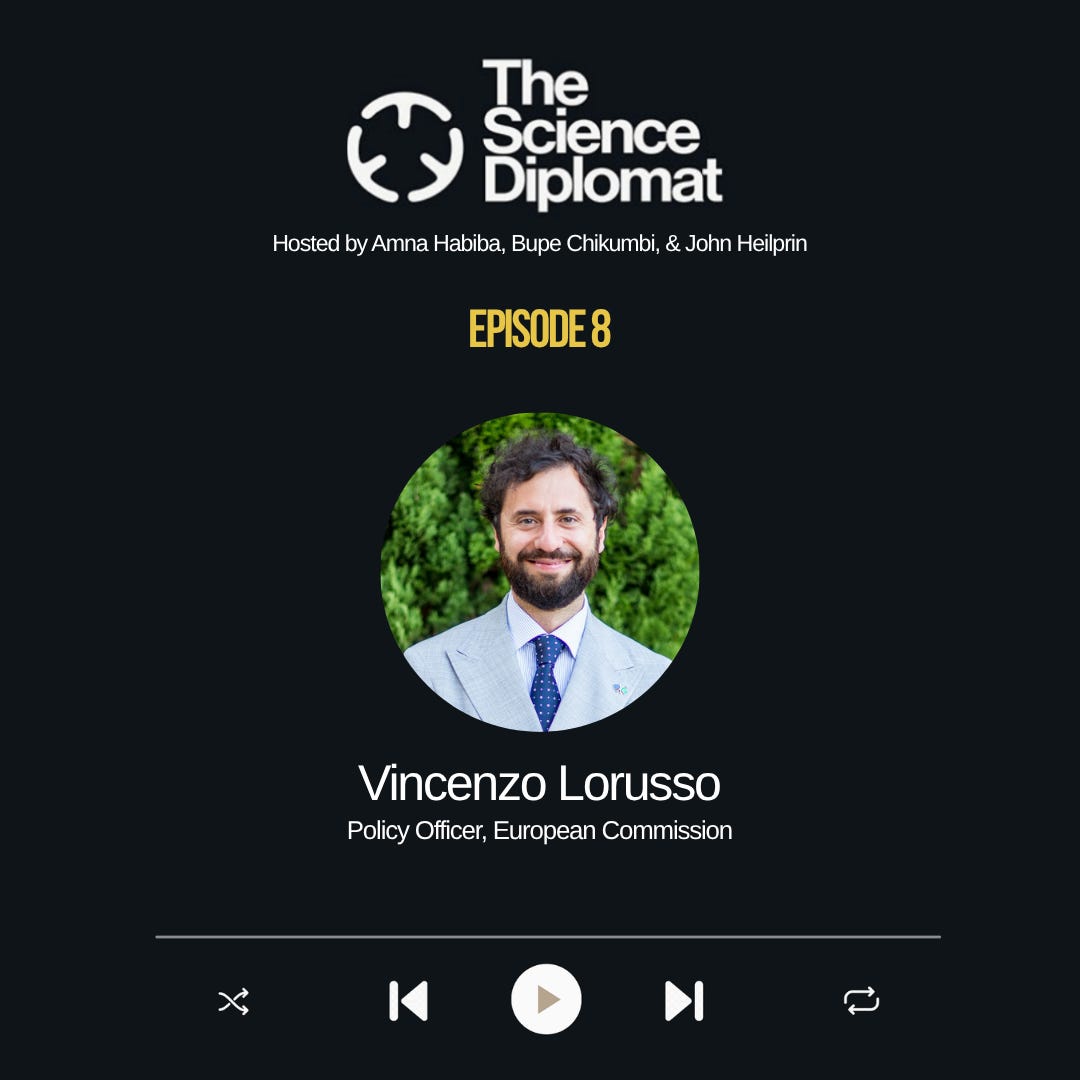
Season 1, Episode 8 — Vincenzo Lorusso on Africa-Europe science diplomacy, innovation and the path from research to market
Science diplomacy between Africa and Europe is moving beyond research cooperation toward a more strategic question: how to turn scientific collaboration into products, services, businesses and lasting institutional relationships.
In this conversation, Vincenzo Lorusso, a policy officer at the European Commission’s Directorate-General for Research and Innovation and E.U. co-chair of the A.U.–E.U. Innovation Agenda Working Group, reflects on what implementing the decade-long agenda has taught him about science diplomacy in practice. Drawing on a career spanning veterinary medicine, public health, the pharmaceutical and biotechnology sectors, international development and European policymaking, he describes science diplomacy as both a bridge between countries and a form of people-to-people negotiation that operates across institutions, sectors and cultures.
The discussion examines how the Africa-Europe relationship is becoming more strategic as science, technology and innovation take on greater importance in diplomacy, competitiveness and security. Lorusso argues that scientific cooperation can create common ground even when countries diverge on other foreign-policy issues, while emphasizing that collaboration must ultimately produce tangible benefits for both sides.
A major focus is the challenge of moving research beyond grants and into the marketplace. Looking ahead to the A.U.–E.U.–Med Innovation Fair in Bari, Italy, Lorusso explains why the partnership is trying to connect research-derived technologies and science-based startups with investors, corporations, venture capital and other sources of scale-up support.
Registration and expressions of interest are open for the Nov. 25 fair, with the call for expressions of interest closing on Sept. 15. He also sets out a more demanding measure of success: not how many people attend an event, but how many technologies attract follow-on investment, reach users, grow into businesses or enter new markets.
The conversation also looks ahead to the October A.U.–E.U. Research and Innovation Ministerial Meeting in Addis Ababa, where ministers are expected to consider new workstreams on science diplomacy and AI in science. Lorusso discusses why Africa-Europe cooperation is increasingly giving science diplomacy a more institutionalized role and where future tensions may emerge around industrialization, energy, emerging technologies and strategic interests.
The episode closes on the question of what success would look like a decade from now. For Lorusso, the answer is ultimately measurable: more products reaching society, more businesses scaling, more startups entering larger markets and stronger institutional ties across Africa and Europe.
Themes covered:
Science diplomacy between Africa and Europe
The A.U.–E.U. Innovation Agenda in practice
Moving research from grants to products and markets
Private-sector engagement and investment
The A.U.–E.U.–Med Innovation Fair in Bari
Measuring impact beyond events and participation
Africa-Europe cooperation on emerging technologies
The new A.U.–E.U. science diplomacy workstream
Research, industrialization and strategic interests
What long-term success should look like
Recorded on August 17, 2026.
Co-hosted by Amna Habiba, Bupe Chikumbi and John Heilprin.