
The Architecture of Science Advice: A Conversation with Rémi Quirion
Québec’s chief scientist reflects on building systems of trust, coordination, and evidence that operate across government and global networks.

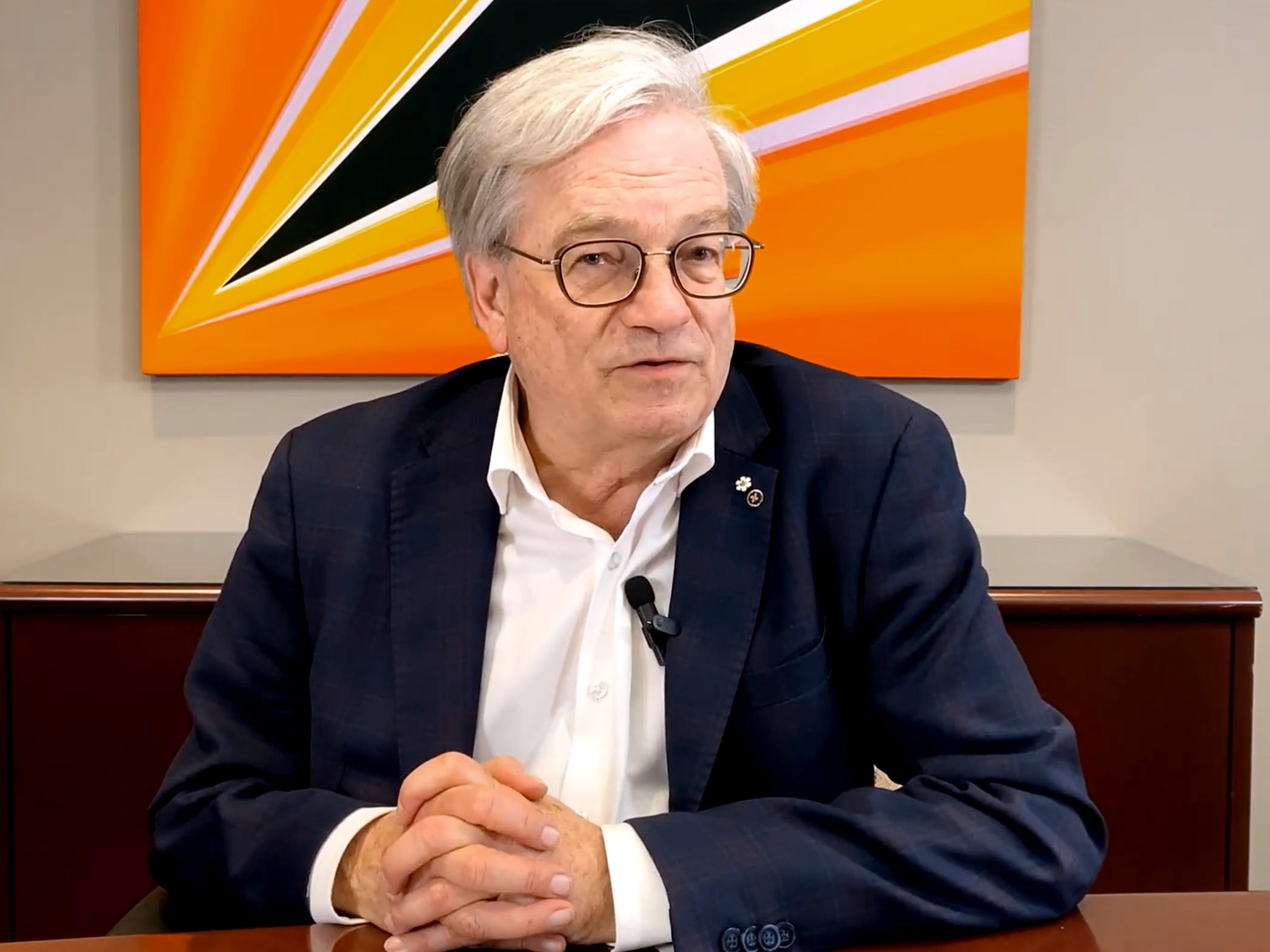
Season 1, Episode 3
Duration: 44:22 minutes
Recorded: April 6, 2026
Dr. Rémi Quirion, Québec’s chief scientist, head of the Fonds de recherche du Québec (FRQ), and president of the International Network for Government Science Advice (INGSA), joins The Science Diplomat for a conversation on how science advice systems are built, sustained, and tested under pressure.
Drawing on his experience creating Québec’s science advisory infrastructure from the ground up, Quirion describes science advice not as a single point of interaction between knowledge and policy, but as a long-term institutional system requiring coordination across government, academia, and funding structures. He emphasizes that scientific evidence does not determine decisions, but informs choices shaped by political, economic, and social considerations.
The conversation examines how trust is established and maintained between scientists and policymakers, particularly in environments where uncertainty is unavoidable. Quirion reflects on the role of repetition, consistency, and independence in building credibility over time, noting that science advice depends as much on relationships as on expertise.
The discussion also explores the structural features of Québec’s model, including the integration of advisory functions with research funding through the Fonds de recherche du Québec. This dual role enables coordination across disciplines and institutions, while raising questions about how influence is exercised within government systems.
Beyond Québec, Quirion reflects on the global expansion of science advice through INGSA, which now operates in more than 130 countries. He emphasizes that effective systems cannot be transferred wholesale, but must be adapted to local political and institutional contexts, with capacity-building framed as partnership rather than replication.
The conversation situates these developments within a broader geopolitical environment marked by fragmentation, shifting research alliances, and increased pressure on multilateral cooperation. In that context, science diplomacy is described as a practical mechanism for sustaining dialogue and collaboration where formal political channels may be constrained.
Finally, Quirion addresses emerging challenges, including the role of artificial intelligence in shaping how evidence is produced and interpreted, and the need to preserve human judgment, ethics, and contextual understanding within decision-making processes.
The discussion returns to a defining moment early in the COVID-19 pandemic, when asked what was known about the virus, Quirion’s answer was: “nothing.” That tension between uncertainty and decision-making remains central to how science advice operates.
Listen to the full conversation below.
The Science Diplomat Podcast — Season 1, Episode 3
Key Themes
Science advice as institutional infrastructure rather than episodic input
Trust, credibility, and repetition in policymaking environments
The boundary between scientific evidence and political decision-making
Design and coordination of science advice systems within government
Global variation in science advice and capacity-building through INGSA
Science diplomacy as a mechanism for sustaining cooperation under geopolitical strain
Artificial intelligence and the future of evidence in decision-making
Transcript
This is the verified transcript of Season 1, Episode 3 of The Science Diplomat podcast, featuring Dr. Rémi Quirion. The text has been lightly edited for clarity and minor transcription corrections. The substance of the conversation has not been altered.
Amna Habiba: Welcome to Episode 3 of The Science Diplomat podcast. Imagine being the top scientist in the country during the most terrifying health crisis in a century. The premier of Quebec looks at you and asks, ‘What do we know about this virus?’ Most people would pivot, but Dr. Remi looked him in the eye and said, ‘Nothing.’ Science advice is often discussed as a bridge, but today’s guest argues there’s actually a massive, largely invisible infrastructure, one he has been building for over a decade. Dr. Remi didn’t start in a government office. He started in the lab as one of the world’s most cited neuroscientists, eventually becoming Quebec’s first chief scientist, president of the International Network for Government Science Advice, and the person responsible for helping connect science to decision-making across many systems. This episode focuses on how those systems actually work and what it takes to build them. Dr. Remi, I wanted to ask you this. You’ve built your career as a neuroscientist and then moved into creating science advice systems. What led you to step away from research and into shaping how knowledge is used in government.
Dr. Rémi Quirion: Well, I was very, very fortunate during my career as a neuroscientist at McGill University in an institute in mental health. I had a great student, postdoc career, probably too many publications for my own good. So things were going very well. And then the government came to me, and said, ‘Yes, you should take it.’ I was not convinced at all at the beginning. But then at some point I said, ‘Yeah, maybe I could train a few more students. Maybe I could publish a hundred more scientific papers.’ Unlikely I’ll get a Nobel Prize or whatever. So maybe I could help another way. And decided to jump into the new position. One of the attractive features in Quebec was that I would be the first one. So you start from nothing and you try to build it. That’s always what I’ve been trying to do during my career.
John Heilprin: Was there a moment when you realized that producing knowledge just wasn’t enough and the real challenge was how it connects to decision-making?
Dr. Rémi Quirion: Yeah, certainly early days, even as a scientist, when I was at McGill, I had still, at that time, really at that time, I had quite a bit of collaboration with government, especially with the Ministry of Health and Social Affairs. And of course, the language of the two worlds were very, very different. It’s like one speaks English and the other one’s not only French, it’s kind of Mandarin or Chinese. So you have to learn the language of the other. And I said, well, maybe that would be an interesting challenge, to try to connect more strongly with policymakers, decision makers, but also elected officials. So at the beginning, the way I started was by doing a tour of the various ministries in Quebec, meeting with deputy ministers, meeting with elected officials. And trying to convince them, in a sense, that I’m not there to take their job. I’m there to work with them and to add value to what they do. And in the end, it’s not me. There’s not a chief scientist anywhere in the world that makes the decisions. It’s the elected officials that say, ‘Oh yes, we consider science, but also other things.’ So we have to adapt to that situation as well that, basically, the elected official will make the final decision, but hopefully it will be informed by science.
John Heilprin: Going back to what Amna referenced when the premier told you that you couldn’t say that publicly, because people would panic. How in general do you navigate that tension between scientific honesty, where ‘I don’t know’ is a valid answer, but in the political world where that uncertainty is often seen as a weakness?
Dr. Rémi Quirion: Yeah, that’s a very good point. And I think what I try to do, and colleagues that have a similar job are trying as well, it’s always better to stick to the data, to stick with the most current, valuable information. Instead of trying to make a story, when you try to make a story, often it backfires. So basically, you’re honest. You see, this is what we know. Could be option A, option B, this is what we don’t know, the advantage and disadvantage of both. And then in the end, you will have the trust of these guys, of these officials. And I think it’s much better to keep the trust of these officials, instead of trying to convince them when you don’t have data that are not solid. But of course, I think this was kind of the way it was going for the past 10, 15 years since I’m on the job. The past two years have been a bit more challenging, and maybe we’ll discuss that a bit more in detail. But of course, what’s happening, for example, in the USA, but not just the USA about science, basically you have data, you show that to the government, and basically some of them will say, ‘Well, I have data too, I don’t believe you.’ So that’s a very challenging now new world that we are into, and that’s why, in my mind, science diplomacy is more important than ever.
Amna Habiba: I wanted to just go back to your role as a chief scientist. You’ve built the office of the chief scientist from scratch in 2011, with no job description, and have now served under more than a dozen ministers, if I’m not wrong. The role was created because there weren’t strong enough links between the research world and the government. What do you think wasn’t really working? And when you kind of stepped into this role, what did you see changing around you?
Dr. Rémi Quirion: I think one of the main objectives when the government during that time decided to create the job, was for them to have a one-stop shop in a sense. They were interacting with experts in university, in institute, already doing that, but they were usually, let’s say, you’re in finance, you know one person at one university, and you always contact the same person. It’s not that the person is good or bad. It’s just that you don’t have all of these connections. So basically, one of the objectives was, well, when I have a question, I will call Rémi, and he will be the one having to find the expert in the network. So instead of the minister or deputy minister trying to find a best person, it was on me. They say, we’ll have a one-stop shop, all members of government use the same one, and then it’s my challenge to try to find an expert to where they are in Quebec. And in a sense, not only in Quebec, it could be international as well. But Quebec’s a relatively small community. So after a little while, you know almost everyone. So that makes it a bit easier. And maybe I was a bit lucky in the early days, to when I had a question like thatm to find the right expert. And that they give the right advice to government, and then you build the trust of the elected officials. That’s probably the way it happened the first few years.
John Heilprin: You’re talking about it being a small community, but Quebec is, at least, the land size is bigger than a lot of countries. And I think you’ve now been the longest-serving chief science officer in a government capacity, longer than anyone else in the world. Is that correct?
Dr. Rémi Quirion: Yeah, and that’s also because of the way it’s organized in Quebec. The position of the chief scientist is defined in the law, so it’s not dependent on the government of the day. So I have been doing it for a different party for a different government. So they could always get rid of me, fire me, almost anything, but they have to go to the national assembly and discuss in the national assembly with the other party. So it’s a bit more challenging. Usually the format that we see in most countries is elected. The person is chosen by the government of the day. The government changes, the whole crew changes. So we see that in the U.S., often the U.K., in Australia and New Zealand. So that’s a model where there is — my bias — that there is more stability in the Quebec model that does not depend on the color of the government. So you have some kind of stability. Of course, you need to renew these types of offices, but there is a bit more time and less pressure in the political system that we have in Canada, which is kind of a British type of system.
Amna Habiba: Do you think that having that sort of influence over funding makes science advice more effective? I mean, you’re in that role with the government, but you’ve also served as a scientist, right? Or do you think it introduces new constraints for you or in that workspace?
Dr. Rémi Quirion: In my own experience, and again with the different governments over the year and many ministers, it was a good thing. It was a positive thing. Of course, I was not involved at all in the decision-making process. The peer review panel, I had less to say in the sense than when I was at McGill, and I was involved with many kinds of reviewing, many proposals. Then it was more like saying the overall guidelines, in terms of the priority, supporting research on all aspects, all fields, the next generation of scientists. So the general thing like that, and having a bit of support, financial support, when you have some special thing that you want to do. Again, during the COVID pandemic, we were able to very quickly establish a bank, a biobank of samples in Quebec. One of the first ones in the world. And then the rest of Canada followed us. But it was because we had a bit of cash to be able to do that. The network of a chair in science diplomacy is a bit of the same thing. I discussed with the government, they said, ‘Yes, go for it,’ and then we had a bit of financial support to be able to act on it.
John Heilprin: What have you learned in your job that you think that maybe it’s hard for anyone else to see, because you’ve served in this position longer than anyone else?
Dr. Rémi Quirion: I think I mentioned that a few times already, but trust is certainly key. Keeping the trust of elected officials, independent of the political orientation. This is very important. Never taking anything for granted, because sometimes as scientists, and that’s what I was doing before, you go, you meet with one minister, you just add a paper in a prestigious journal and you summarize it for that person. You think, that’s it, it’s done, your job is done, no. You have to repeat and repeat and repeat, because they have so many things on their minds. So you’re never taking anything for granted. So you have to repeat the same type of story over time, because often they may tend to forget it. And also you have to bring on new information as they come along. Of course, especially again, during the pandemic, things were changing every week almost, because we’re learning about the virus, learning about the science behind the COVID-19. So that was changing. It was challenging to convey that to government, to our elected officials, but in the end, I think they started to appreciate science and the way we build science even more than before.
John Heilprin: Would you call yourself a science diplomat?
Dr. Rémi Quirion: In a sense. I’m a science advisor. And, of course, I did that a lot in Quebec, but early days. Quebec has many, many offices all over the world. So a lot of international activities as well. So in a sense, I became probably a science diplomat over the years. It was not at the beginning, certainly it was not the plan, it was mostly for Quebec. But with time, I started to see, well, we needed to show the type of influence that can have abroad, and science diplomacy is one tool that we are using.
John Heilprin: While we’re still on the subject of you being chief scientific officer, I’m wondering about relations with the U.S. Because, of course, there’s a different picture going on in the United States, and I’m wonder what the relations are like? Do you have a counterpart that you deal with? And relations are strained between the two countries right now?
Dr. Rémi Quirion: It’s quite surprising still for me. I never expected to live through that in my lifetime. Because, of course, the U.S., in terms of power and science, excellence in science was a gold standard, even more than a gold standard. And we were collaborating. I did some studies at the NIH in the state for my postdocs, a lot of links, collaboration, at the scientific level, but also interactions with the federal government in Washington, D.C., with state governments, and so on. And almost from one day to the other, different mindset, very, very challenging. So I, in my job, was still trying to help colleagues in the U.S. that are working in disciplines that are not popular there anymore, like, let’s say climate change, vaccine, mRNA vaccines, these type of things. Trying to offer them maybe a way to come to Quebec, to Canada for a little while. They may decide to stay, they may decide to go back later on, we’ll see. So that’s one thing. Also for our students, because in the Quebec research fund, we are providing a postdoctoral award. And 80% of our PhDs getting the awards were going to the U.S. for postdocs in all fields, social sciences, humanities, engineering, health. From one day to the next, they cannot go there or don’t want to go there anymore. So basically the answer is okay, well, we try to see what kind of links and partnerships we can develop with various countries in Europe, or in Asia and all that. But it’s still difficult because, of course, the U.S. was investing a lot in, let’s say, longitudinal studies about the ocean, about the Arctic. From one day to the next, they are not there. And we don’t have the means to replace them from one day to the next. So I think we have to continue to help to support the scientists in the U.S. For us, more and more, we’re working at the level of states and the level of cities, many, many states, for example, because probably the richer ones, like Michigan, like Massachusetts, New York state, they say, well, ‘If the federal government doesn’t believe in this, in climate change, for example, we do.’ So how can we continue to work with you? The cities of New York, Boston, Boston with Montreal, are now discussing science diplomacy, having joint partnerships in science diplomacy. So I think we’re trying to find other ways to work with colleagues in the U.S. But certainly it’s a challenging type of time for all of us, and also bridging with countries, especially in Europe, that have the same approach to science, trying to have stronger partnerships with them.
Amna Habiba: You talked about your own journey, the transition from academia into government, and you’ve pushed hard on public engagement, appearing on platforms like Polis, where public interest in science was overwhelming. For many young researchers, though, moving towards policy can feel very risky. How do you convince a student who would like to go into science, or a PhD student, let’s just say, that pursuing policy is worthy enough?
Dr. Rémi Quirion: I think first is to convince a younger generation to go into science, that science can be fun. In Quebec, in Canada, often when I discuss with a young adult, I try to say, well, maybe, as a man, you’d like to play for the Montreal Canadiens, play hockey, but it’s as fun to do science if you learn something about a star, if you learned something about a bug, and a vaccine, and develop a new molecule. So it’s not easy to do that, but trying to say that science is for, I will exaggerate a little bit, but almost for everyone. It’s not just for the happy few. Just that probably the way it’s taught in high school and college, maybe it’s not the most exciting for some people. So we need to change that as well. Especially when you’re a teenager and the group has a very important thing. So if one is in science, the other one finds that he’s a bit nerdy. So I think we have to change that and do more like science. The practice of science is probably what needs to be done at that stage. It’s done, but we need to do more. Then the next step is to go to a science policy, science advice, and of course, chief scientists. I remember when I saw on my business card, chief scientist of Quebec, my God, this is quite pretentious to have a business card like that. And if someone would say, ‘Oh, I’d like to become one,’ this is hard and very few, happy few. But on the other hand maybe thinking of working in government, in science policy. And if you can improve on the law that’s being discussed in government, my God, the impact of that may be much more than many people that publish in Science or in Nature. So that’s why we have also started a program to offer a PhD student to go to work in ministry in the Quebec government, as we do in the Quebec office abroad, and now, more recently, in the cities to be associated with the level of cities with mayors, and providing science and science advice, because that’s very concrete there. When you have flooding, the mayor needs to have a solution - for that you don’t have to write a PhD thesis. So I think providing opportunities like that for the young generation, and showing to them that science policy, science advice can have impact in society, and the younger generation really will like to have impact and often they are frustrated, rightly so, for example, with climate change, that there are all kinds of discussions, but not much has happened. But I think if we make it closer to the ground and are showing them that it’s possible to have impact, and that their advice can have impact, and I think then they start to talk to their colleagues, to their friends, and slowly but surely, you build the crowd that way. So that will be my suggestion.
Amna Habiba: When would you suggest scientists or prospective scientists to start thinking about at the undergrad level or the graduate level? For context, I’m doing my bachelor’s in science right now, but I would love to transition into a policy-making space. At the same time, when do you think a student particularly would be ready to move into a more policy-focused role? How much science do you really need to know before you can step and advise in a government setting?
Dr. Rémi Quirion: My bias would always be to start early for science, science advice, science policy. You need to start very early in the game to show to the younger generation there are various opportunities in science, including science advice. And maybe a bit of exposure to that at the undergrad level is a good thing. Working maybe in the ministry, having a few weeks, a few months type of training program. That exists in some places, not generally enough, not everywhere. I think we should build on that. And then of course, as you get toa higher level, like masters and PhD, of course then you have more of a background in science to be able probably to judge a bit more what’s good science, not that great science. So I think, but I think early, for me, earlier will be better. And maybe also when you have a bit, do that a bit early in your career, then you realize, ‘Oh, I was thinking that I would like it, but that’s not really for me.’ So you have it when you are working in a ministry, for example, and going just for a few weeks there, you will find out if it’s really something you like to do in your life.
John Heilprin: I want to talk about this new initiative that Quebec has launched, one of the most structured investments in science diplomacy to date. It’s a network of university research centers funded by your offices. Can you just tell us more about that, the significance of it, what you modeled it on, what problems you’re trying to solve, what are your long-term goals?
Dr. Rémi Quirion: Yeah, I think Quebec is always a bit different. And of course, as I mentioned before, we have many offices abroad. It’s one of the only provinces in Canada that has that. So we have offices in many cities, many countries in Europe, in the U.S., in Asia, in Africa. These types of offices are there to link to the economy, the economical level, interaction between business in Quebec and business in those parts of the world. But also higher education is one of the important ones. Culture, the culture of Quebec, is very important, French and all that French culture, is important, science in French, having a training program to send scientists to these offices abroad. So that started a bit from there. We’ve been building that over the past few years. We now have about 15 or 16 of these, it’s what we call scientists in residence abroad. And they are fabulous. Now I have been creating networks, exchanging, and all that. Seeing that, then I mentioned to my government, ‘Well, maybe we could go now another step in that field, and start having chairs in science diplomacy.’ So to having really a person or a group of people that will focus on science diplomacy, at least for a little while in their career. And what we decided to do, and the government was very, very positive, and what we decided to do is to create a program where each university in Quebec was allowed to submit one proposal. So we have 18 universities in Quebec. So we opened that last year, last spring. They submitted a proposal on science diplomacy, or maybe focusing on some aspect of it, being specialized, for example, in science diplomacy in the Arctic, in the northern part of Canada. But we were very open to them. And myself, I was not involved at all with any of the decisions. We had a peer review panel that looked at the proposals, and in the end they recommended that we support, that we should fund eight of them. And I must say, it was quite surprising. Very happily surprised by the outcome where, without asking them, without telling them what to do, they all came with a proposal saying, myself, with a partner, of course, science diplomacy needs to be with a partner at the international level. So each of them had a partnership with various countries, and one of them decided to focus on climate change. Another one, they focus on the Arctic. Another one, they focus on food security. Another one, they focus on the governance of AI, and one on knowledge from the First Nation on the impact on science diplomacy, with a country in Europe, with a country in Africa, a country in Latin America, and a country in Asia. So I was very happily surprised. And when we launched it a few weeks ago, we asked each of the chair holders from Quebec, from Quebec University, to invite at least one of their partners at the international level. And it was like fire. It was amazing, beautiful to see — each of them had a few minutes to present what they wanted to do, what they had proposed in the context of the chair. And immediately they started to say, ‘Oh, I need to talk, I need to work with the other one.’ So to almost build the network on that day, in a sense. So there is a lot of interest. There’s a lot of interest locally, here in Quebec, in Canada, but a lot of interest at the global level as well. A few days ago, I was at the head office in UNESCO in Paris, and they were very, very keen on that. They’d even say, ‘Oh, maybe the next meeting of that group should be at the head office of UNESCO in Paris.’ So I think, I’m quite optimistic that in the end that will have impact, the visibility of Quebec, in terms of science, in terms of science diplomacy and science advice, in various fields. And I hope that very quickly other parts of the world, other countries or regions, will do the same and will do even more, will have even more chairs than us, and that it will be creating a network of networks, in a sense. And your shop will be very key on that, to follow up and try to know what works. Probably with some things, something will work well, others will probably not. But just seeing the enthusiasm of the chair holders last week was amazing.
Amna Habiba: So I wanted to move on a bit to your work with INGSA. Since 2021, you’ve been the president, and it operates across more than 130 countries. What drew you into that global role? And how do you think it’s changed your understanding of science advice across different systems?
Dr. Rémi Quirion: I think when I started as chief scientist, of course, I had no blueprint, no textbook on what do you do as a science advisor. So I just jumped into that and in the first couple of days on the job, my minister at the time, when I said, ‘Well, I’m here now, what do I do?’ Because I did not know. And he said, ‘Oh, I wanted the chief scientist early on. Okay, now we need to build.' So I called the chief scientist at that time in the U.K., in Australia, in the U.S., in New Zealand. Finally, Peter Gluckman, who was the chief scientist in New Zealand at the time, organized some kind of a meeting. And some of us said, ‘Well, maybe we should try an exchange.’ I would not call it a best practice, because it was fairly early days. But what did we learn over the past few years? How can we help each other? So very loosely, we did not even have a name at the time at that meeting, but then said, ‘Okay, we’re having Peter and a few colleagues establish some kind of a structure.’ That became — it stayed very, very loose. But they had a lot of appetite, especially from the Global South. The first kind of science advice training program that we had was in South Africa. Then in various parts of the world, we started to create chapters. And when Peter decided to step down and was appointed as president of the International Science Council, they suggested, some member of the group suggested, well, maybe you could take over. And it was a bit, it was interesting for me, because I was not — I was in a region, not necessarily at the country level, but I had support from the French, support from the Quebec government as well, and still continuing to focus on building capacity in science advice all over the world, focusing especially on the Global South. So what I learned is that basically, there is no — we’re trying to support the development of science advice everywhere, but there is no one formula that will work for everyone. So depending on where you are in the world, depending on your culture, depending on your language, you have to adapt the type of advice that you are giving. And often it’s something that we tend to forget, especially from North America or whatever, you say, ‘Oh, I know it all,’ and you go there and you say you should do A, B, C. And often they will be very polite. They will not say much, but then nothing happens. So instead saying, ‘Okay, you have a problem, you have the challenge, how do you like to go about it?’ And then they build it and you try to support them. So basically that’s what INGSA has been trying to do over the past few years. And again, as I said, mostly in the Global South, yeah, and the chapter in Africa is doing quite well, Latin America, a new person there. Asia is still building capacity, but doing well. We created one in Europe a couple of years ago. And of course there, there is a lot of structure, a lot of organization, the kind to do science advice. So we did not want to duplicate anything. So it’s Claire Craig at Oxford that took that chapter. And basically that is what I was mentioning — so what was the impact of culture and language on the efficacy of science advice? And Europe is fabulous for that, with all the countries, all the languages, and all that. So that’s one of their main areas of focus. And we are developing one in North America. And that one decided, the group in North America decided to focus on building capacity and science advice at the level of cities, at the very local level. And it’s not just North America that kind of needs that. It’s all over the world. The pilot will be more and more in North America. And as I mentioned a bit earlier, a lot of interest from cities and with what’s happening, for example, in the U.S., and them saying, ‘Well, for us, climate change is important.’ How do we go about it and working with other cities to learn from each other? So it’s really, again, building capacity and science advice. And by doing that, I think we are also, we’ll have an impact also on science diplomacy. For me, to have good science, diplomacy and good science.
Amna Habiba: I found it really interesting that you brought up Sir Peter Gluckman, since we had him on the podcast as our first guest. So I’m a bit curious, when you’re collaborating across countries with really different capacities, what’s actually the hardest thing to build? Is it structure, expertise or trust? And how do all these different organizations really interact in reality?
Dr. Rémi Quirion: I think of how can we help each other, or how can can we help the partner. So usually that’s the way we try to go about it. My day job as chief scientist, but also with INGSA, is trying to help each other. In addition to that, of course, financial support always helps. So we have a bit of financial support as well for the chapter, but especially in the Global South. They can do a lot with a relatively small budget. They know that they have good network, like in Africa, in Asia, Latin America. So when they connect with each other, the impact is amazing. So I think letting them do what they want is important, trying to help them. And in Europe, or North America, where it’s different, the same thing. What will be the added value? What is the added value of an INGSA chapter in Europe? And one of the things is that we’re kind of a neutral convener. We had a few meetings in Brussels and the colleagues from various groups said, ‘Well, it’s nice to be together. We have never had that opportunity.’ Because sometimes they see each other more as competitors than collaborators, and being around the same table, maybe they could do this together without affecting their day work, in a sense. So that’s really what we’re trying to do — be a convener trying to help the various countries that want to build science advice and science diplomacy.
John Heilprin: Could you follow up a little bit more about competition versus collaboration, how that actually works?
Dr. Rémi Quirion: Of course, training as a scientist, you’re used to competition. Yes, you collaborate a lot, but in the end, it’s really more of a competition. So you have to change a little bit the mindset. I’m saying that by collaborating, how it will help me, it will help me to go faster or to reach my objective sooner or to have more of an impact. And there, in a sense, is what’s happening in the world, especially in the U.S., the crisis in science, is helping. Because we, as a big partner that we are losing, so now we say, ‘Okay, we have to work with others that are similarly minded all over the world.’ So they collaborate. So yes, probably there’s still a competition between let’s say, Canadian scientists and scientists associated with Horizon Europe. But more and more we say we need to collaborate. We need to work together if we want in the end to have some kind of an impact on climate change. So I think the mindset is changing a little bit, and of course, one of the things we have to do is to trust, trust the collaborator. So often I would say be a good collaborator instead of competitor. Collaboration isn’t enough. It has to be a bit of a partnership, like a couple. You have good days, you have bad days, but you are there for the long haul. And I think there, what’s happening again, worldwide, is helping us in that sense.
John Heilprin: I’ve got a couple more follow-up questions on that: whether as a competitor or a collaborator, how high a priority is science diplomacy for Canada and for your province at this point? Is it essentially a top priority at this point?
Dr. Rémi Quirion: I think, yeah, I was lucky, it was a few years ago when we started to think about it, but now more and more, especially since we have lost one big partner. Science, policy, science diplomacy is seen as something essential. We are developing a strategy for the province, science diplomacy, and we’re not the only one. The Japanese government just released their own science diplomacy policy. So I think all of us are realizing that it’s not the only thing that’s needed, but certainly in the current world, science and science diplomacy is a way to move forward, instead of just building a frontier, adding a frontier, adding a wall between countries, science can be a bridge. So that is very important for us.
John Heilprin: And we started talking about this actually before we started recording this — a little bit about how science diplomacy has been going on actually for centuries, arguably, just not under that name. And I’m wondering now, the U.N. is in the process of picking a new secretary-general. Is it fair to say that the secretary-general’s job is essentially, in some ways, the world’s top science diplomat? Or, can you say that the president of the European Commission, who does happen to be a doctor and a politician, is she a science diplomat? And, if you extend that, are many of these leadership roles science diplomat jobs, whether or not they have a background in science and diplomacy?
Dr. Rémi Quirion: I think you can become a science diplomat by practicing it, you don’t necessarily need to be a neuroscientist like me, or whatever else. I think you can learn that, you have to be exposed to it for sure. I think, hopefully, there’d be more and more high-level decision-makers in government, at the local and the global level, who will be science diplomats. It will be great if the next secretary-general is a science diplomat, or thinks that she or he is a scientist diplomat. Of course, there are many other things that they have to think about. And today, the multilateral organizations are under a lot of challenges. But there, I will argue that science diplomacy can help. Like with culture, probably they need to do both science diplomacy, cultural diplomacy, and probably economy as well. But certainly science should be part, one key part of this type of job.
Amna Habiba: I want to just go back to when you mentioned Horizon Europe. Where do you see AI and technology advances showing up in newer projects? And is it starting to influence how scientific advice is generated or used?
Dr. Rémi Quirion: Scientific advice is generated most likely, used probably by us and by different colleagues. I will give a talk tomorrow on AI and democracy. And certainly there is science advice, science diplomacy included in there. So I really believe that AI will help science advice and science diplomacy. But you have to be careful also not to go to the other extreme, that basically all your suggestions or recommendations to elected officials come from algorithms. So I think there is a lot still in the culture, as I mentioned before, and the successful delivery of science advice and science diplomacy. There are still a lot of human traits behind science advice and science diplomacy. I see AI, like in other fields, as a tool that can help us, but it should not become what will rule science, science diplomacy, or diplomacy altogether. But it has challenges. So we’re still in the learning phase. It’s still new. It’s still changing very, very rapidly. And probably, although it’s challenging, there will be kind of guidelines or rules that will be established over the next year, led by various countries, and it’s probably a good thing.
John Heilprin: Since you are a neuroscientist, and the fields of neurotechnology, with things like brain-computer interfaces, AI — all of these things are converging in really exciting and terrifying ways. I’m wondering, how do you handle that? What kind of advice do you give on that? Can science diplomacy help find ways to govern or to create solutions to these? How does that work?
Dr. Rémi Quirion: I think ‘solution’ probably would be a big word, but of course, UNESCO, for example, they had a think tank on neurotechnology over the past little while. I think there is a lot of opportunity in them on AI and the brain, neurotechnology there, repairing the brain, people that suffer from spinal cord injuries, for example. So I think there is a lot of opportunity. Where you have to be careful is, again, at the other end of the spectrum, the negative side of it, that when you start to control the brain with various types of devices that control learning and memory for different purposes. So I think the field that we need to focus more on is neuroethics. What are the ethics of brain functions? And come with general guidelines globally on that — a bit like we did with genomics — and making human beings, in a sense, with technology. So I think we need probably fairly quickly to come up with some kind of a resolution on that at the global level.
Amna Habiba: I wanted to move to this moment of wonder. You’ve reached the heights of global policy and you continue to break that ceiling, but you still talk about that moment of wonder when a student shows you something under a microscope that maybe no one has ever really seen before. After 14 years, do you still find that wonder in, let’s say, a cabinet meeting?
Dr. Rémi Quirion: A good question. Probably a bit more challenging, I would say. There’s something hard to reproduce in terms of feeling, maybe just because as a scientist, when you’re with your student or a colleague and you see something for the first time in the history of mankind, this is quite a unique moment. Then it takes 10 years to convince anyone it’s important. That’s a part of science as well. When you deal with elected officials, with high-level policymakers, I think probably the moment of wonder for me, it’s probably more when you improve on the rules, regulations, improve on the laws. Then this has impact on your fellow citizen. That’s not exactly the same feeling that I would express, but it’s very satisfactory as well. And it’s rare that you are alone there. It’s more as a team, I will say, to make things like that move and to improve on laws, for example, but it can be quite satisfactory.
Amna Habiba: Well, Dr. Rémi, thank you so much for joining us on The Science Diplomat and for reminding us that in science, “I don’t know” is often the most important thing you can say.