
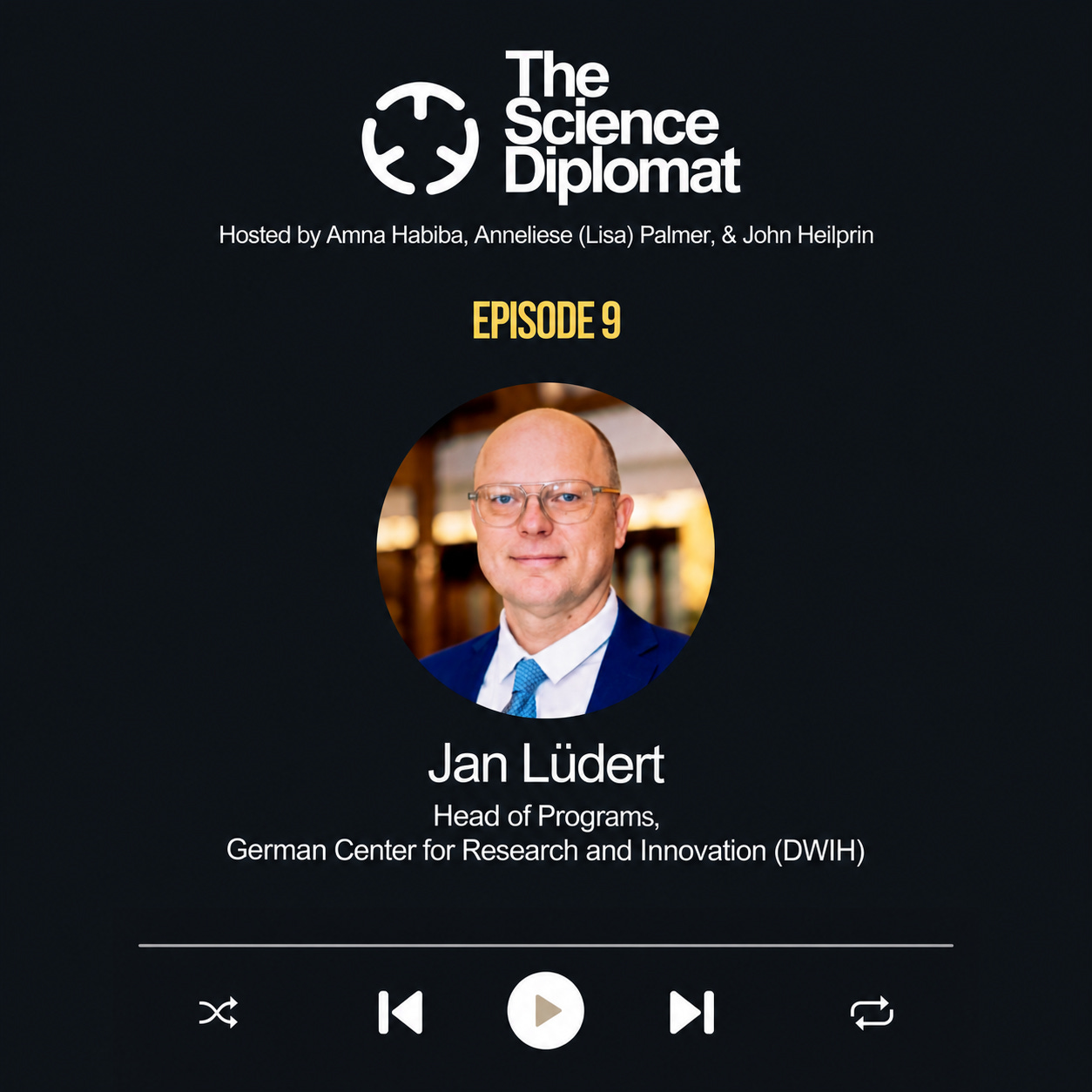
Season 1, Episode 9 — Jan Lüdert on science diplomacy, global power and the future of scientific cooperation
Science diplomacy is no longer simply a matter of governments using scientific cooperation to build bridges. As artificial intelligence, geopolitical competition and concerns about research security reshape international relations, a more fundamental question is emerging: who decides how science is conducted, shared and governed?
In this conversation, Jan Lüdert, Head of Programs at the German Center for Research and Innovation (DWIH) in New York and co-editor with Martin Wählisch of the Palgrave Handbook of Science Diplomacy, examines how technological disruption and shifting geopolitical interests are transforming the field. Drawing on the handbook’s 28 chapters and contributions from 52 scholars and practitioners, he argues that science diplomacy must be understood through a broader network of governments, universities, international organizations, companies and other institutions that exercise different forms of authority.
A central theme is what Lüdert calls the polycentric nature of contemporary science diplomacy. Governments remain powerful, but they no longer control every element of international scientific cooperation. Universities shape research partnerships, companies own critical computing infrastructure, and international organizations help establish rules and standards. Understanding where authority, expertise and infrastructure reside is essential to understanding how science diplomacy works.
The discussion explores how this changing balance of power is playing out in artificial intelligence. Lüdert examines the growing influence of technology companies, the difficulty governments face in regulating rapidly developing systems, and the competing strategic interests that complicate international cooperation. He also considers whether science diplomacy can help establish accountability when responsibility is distributed among public and private actors.
Germany’s approach to science diplomacy provides another perspective. Lüdert describes how scientific cooperation, traditionally associated with soft power and bridge-building, is understood as an instrument of national interest and strategic capability. The conversation examines the implications for German-American and broader transatlantic research relationships, including cooperation with Canada amid changing political circumstances.
The episode also addresses the persistent underrepresentation of Global South scholars and practitioners in science diplomacy, the importance of following funding flows to understand who shapes research priorities, and the challenge of sustaining major scientific projects as public and private investment patterns evolve.
A major focus is the tension between open science and research security. Lüdert argues the two should not be seen as opposing goals. Instead, he advocates a risk-aware approach that protects scientific freedom while helping researchers and institutions recognize vulnerabilities over sensitive technologies, partnerships and research infrastructure. The discussion considers who should make those judgments and whether scientific cooperation should ever be suspended over security concerns.
Lüdert also reflects on the process of producing the open access handbook, which became more than a publishing project. Through workshops, institutional partnerships and public discussions, its contributors sought to build a lasting community of scholars and practitioners capable of examining science diplomacy through both empirical research and practical experience.
The conversation closes by looking a decade ahead. For Lüdert, the enduring purpose of science diplomacy is to connect scientific knowledge with better public decision-making and societal benefits. Even as competition and security concerns gain prominence, he argues international scientific cooperation remains indispensable for addressing challenges that cross national borders, from climate change to pandemics.
Themes covered:
Science diplomacy in an era of geopolitical and technological disruption
The Palgrave Handbook of Science Diplomacy
Polycentric governance and the changing distribution of authority
Artificial intelligence, corporate power and accountability
Germany’s strategic approach to science diplomacy
Transatlantic scientific cooperation and national interests
Global South representation in science diplomacy
Research funding, infrastructure and institutional influence
Open science, research security and scientific freedom
Managing risks in international research partnerships
Building a global community of science diplomacy practitioners
The future of scientific cooperation and evidence-based policymaking
Recorded on September 17, 2026.
Co-hosted by Amna Habiba, Anneliese (Lisa) Palmer and John Heilprin.