
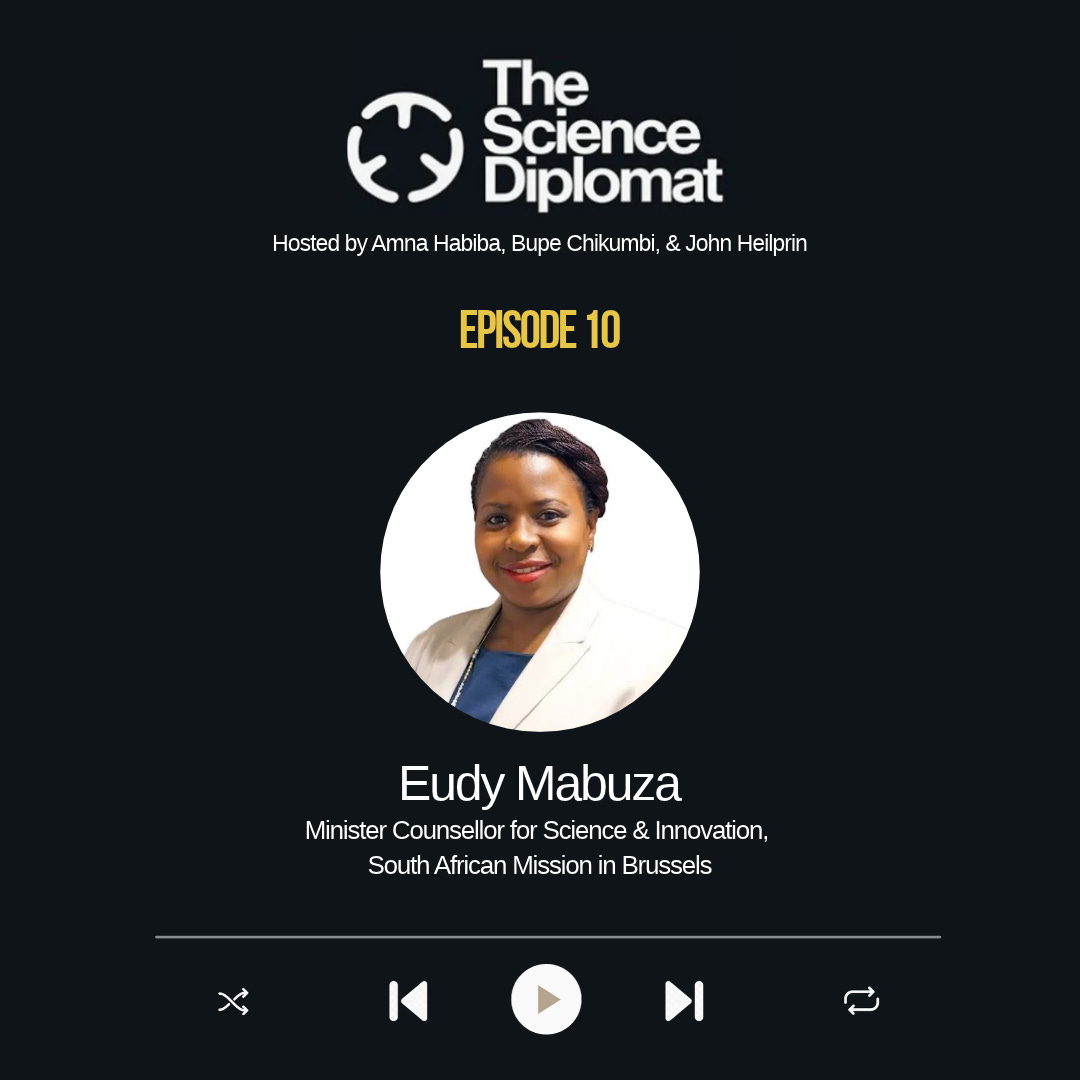
Season 1, Episode 10 — Eudy Mabuza on science diplomacy, global power and the future of scientific cooperation
Africa’s scientific ambitions face a continued imbalance: the continent has substantial research talent, natural resources and opportunities for international collaboration, but receives a disproportionately small share of global research investment. As competition for critical minerals, clean energy and emerging technologies intensifies, African countries are seeking greater influence over how international scientific partnerships are negotiated and whose interests they serve.
In this conversation, Eudy Mabuza, minister counselor for science and innovation at the South African Mission in Brussels, reflects on two decades of science diplomacy spanning South Africa, Japan and Europe. She describes how scientific cooperation intersects with foreign policy, trade and national development, and why navigating political interests can be more difficult than navigating the science itself.
A central theme is the need for world-class research infrastructure in Africa. Mabuza argues that African countries should use their strategic importance in global supply chains to negotiate investment in laboratories, scientific expertise and local industries rather than simply exporting raw materials. She sees an opportunity to build more equitable partnerships with Europe and other international partners while strengthening Africa’s own research capabilities.
The discussion examines South Africa’s negotiations with Europe over green hydrogen and the energy transition. Mabuza explains why decarbonization must also support domestic industries, workforce development and economic opportunities, particularly as European climate policies affect African exports. She also addresses the gap between African governments’ research funding commitments and actual spending, and the challenges of relying on international financing.
The conversation turns to Africa’s role in artificial intelligence governance, efforts to expand access to European research programs for historically disadvantaged South African universities, and lessons from Mabuza’s five and a half years building scientific partnerships with Japan. Throughout, she emphasizes the importance of negotiating power, institutional trust and long-term investment.
The episode closes with Mabuza’s measure of success: young researchers gaining opportunities, building international networks and returning home with the knowledge and connections to improve their communities. For her, science diplomacy ultimately matters because of the benefits it delivers beyond negotiating rooms and research institutions.
Themes covered:
African science diplomacy and equitable international partnerships
Research funding, infrastructure and scientific sovereignty
Critical minerals, supply chains and local value creation
South Africa-Europe cooperation on green hydrogen
Climate policy, trade and industrial development
Africa’s role in AI governance
Research opportunities for historically disadvantaged universities
Lessons from South Africa-Japan scientific cooperation
Measuring the long-term impact of science diplomacy
Recorded on October 5, 2026.
Co-hosted by Amna Habiba and Bupe Chikumbi.